That is, ee-tee-OL-uh-gee. No, it is not the study of E.T.
[Let me warn you at the outset: I get a little philosophical in this one. And what's worse, it's long. If it seems too wordy at the outset, I promise it gets back to my usual style by the end.]
I'm not one to get into prolonged arguments for the existence of God. I'm familiar with many of them, and I'll draw on them from time to time when I need to in conversation, especially if I think it will help someone. But I think that people are more likely to be convinced that God exists because they experience Him in love shown by believers (and even non-believers), or by the beauty of creation, or something else that is beyond reasoning. I say this because, if I only believe in a deity because I can prove to myself he exists, or at least that he most likely exists, then I don't believe in much of a god at all. I believe instead in some being whose existence is graspable and establish-able by my own reason. I therefore have power over him, and am able to be secure in the fact that I am the one in control of my belief, and no one else. That is why philosophical reasoning can only be a beginning, a first step towards faith. It cannot take the place of faith itself (though it does work quite well in harmony with faith).
Thus, I'm more interested in my own constant conversion so that believers and non-believers alike will hopefully be able to see God in me, rather than in their own heads, delimited and packaged into the god they are willing to accept. God is bigger and more surprising than that. Like I said, I'll talk to you any time of day about Anselm's ontological argument, or Thomas' 5 ways, or any of a number of arguments for God's existence, but I don't give them too much credence in the actual convincing of non-believers. I'm fairly jaded when it comes to arguing for God's existence.
However, that doesn't stop me from speaking up when I hear stupid arguments against the existence of God.
I am presently bothered by the conjecture accusing human kind of having constructed an etiological deity. That means, a god that exists as something we came up with to explain things we don't understand. In other words, he is just something we've dreamed up as the cause of the things about the world we can't (yet) explain with science. Once we understand everything (ha!), then it will absolutely clear there is no god. (This of course rests on the demarcation of knowable reality to that which is quantitative, measurable, reportable, etc. The etiological postulation loses an awful lot of weight already if you admit other kinds of knowledge, but many scientists just choose to believe that other kinds of knowledge just aren't possible. However, so far as I know, there's nothing observable in nature that says the only thing you can know is what science can tell you. That's a decision made in the mind of scientists - not all scientists, mind you. It is not a proven reality. But I digress.)
Let me just say this. I don't believe in a god that exists to explain anything to me. So go ahead science - explain everything to me! You won't undo my belief. I believe in God who exists entirely in Himself and doesn't need the world or the human brain to exist. I believe in God who, if He wanted to, could have created the world in such a way that it hold no signs whatsoever of His existence, and therefore, even if we proved that He didn't exist, He still would exist, because He'd be outside our frame of reference. I also believe in God who although He could have done that, He didn't. He wanted His existence to be apparent, and so has revealed Himself through creation, through the seed of the Word present in every inquiring human mind, through His gradual revelation to the People of Israel, and most fully, through His coming among us in the Incarnation.
It just bothers me when scientists cross outside the bounds of their competency and tell us things they have no grounds to say. They'll say that science doesn't present any reasons why a god would exist. But my resounding answer is that even if science did present empirical grounds for the existence of God, I still would not count those as grounds for believing in God. It would be a nice novelty, a sort of icing on the cake, but nothing more. Quit talking to me about what science does or does not conclude about God. Such conclusions are superfluous at best, and nonsensical at worst. (Now, that's different than talking about what reason does or does not conclude about God. Human reason's conclusions regarding God are not superfluous, but still, without revelation and faith, it can't take us all the way.)
I believe in God because I know his Love. If that is a meaningless statement to you, then go spend some time in service to your fellow man. Go spend some time with believers, and I mean serious believers. Go serve alongside the Missionaries of Charity (they'll accept the help), or go spend a week praying with monks (they're required to be hospitable by their Rule), or go live with and help around the house of a large family that prays together and shares meals together every day and goes to Church on Sundays. Laugh and cry with them. Hear their shouting and arguments and then watch their reconciliations.
If you claim not to know the Love of God, then seek it out where it ought to be found, which is not in the cold reality of a laboratory, nor in the observations of a radio telescope, or whatever. I'm sitting right now in a library filled with books about God, but if I were the only person in the world, I could read every single one of these books and I don't think I'd come to believe in God (and let me tell you, there are some good books in here). The Love of God is no more written on their pages than it is to be found in a test-tube. Love is something that only exists in relationships, even the Love of God. And we can't ever be in a relationship with God, unless we experience that Love in the way that He has ordained: in other people. That's how the spread of the Good News works. Nobody hears it directly from God; we believe because somebody else we know believes. (Don't forget to take the time to thank that person, by the way.)
You tell me the universe doesn't give you evidence of the existence of God. I say, well, it gives me evidence, just not the kind of evidence you're looking for. The people who love me give me plenty of evidence. They are my starting point. I dig further (with the help of the Church and Scripture) and I find a font of Truth and Love and Power that can never be exhausted, an infinite that is warmly overflowing, not the cold infinite void of the expanses of space. A God who is immeasurable by anything even conceivable by science, not because He doesn't exist, but because He's not the world. He's something else.
Showing posts with label Thinkin' Out Loud. Show all posts
Showing posts with label Thinkin' Out Loud. Show all posts
Wednesday, January 4, 2012

Saturday, November 26, 2011
What you're meant to be
Many people seem to regret certain things about their lives. They look back and wonder if they've been doing what they should have been doing. They're not sure if they've wasted their lives or not. They don't know if they are who they were meant to be.
But there's a lot of hope still, because I think that Heaven is just going to be the place where we are able to fully be who we were meant to be.
In fact, that's why hell would be so bad. If someone is depressed now in this life thinking on how they haven't done what they were meant to do, imagine doing so for eternity. Imagine never ever being able to be fulfilled. In the absence of God, we cannot flourish. We cannot be who we were meant to be because He intended us for Himself. If we separate ourselves from Him, then we have denied ourselves the opportunity to be fully alive.
To all those who feel lost and think they have wasted their time: no one has to wait to be who they were created to be. Everyone can do that at any and every moment of the day. You just have to tell God you want it: "God, make me that which you created me to be, because I'm doing a terrible job on my own."
Perhaps purgatory is just us becoming who we were meant to be, and then heaven is our enjoyment of it.
But there's a lot of hope still, because I think that Heaven is just going to be the place where we are able to fully be who we were meant to be.
In fact, that's why hell would be so bad. If someone is depressed now in this life thinking on how they haven't done what they were meant to do, imagine doing so for eternity. Imagine never ever being able to be fulfilled. In the absence of God, we cannot flourish. We cannot be who we were meant to be because He intended us for Himself. If we separate ourselves from Him, then we have denied ourselves the opportunity to be fully alive.
To all those who feel lost and think they have wasted their time: no one has to wait to be who they were created to be. Everyone can do that at any and every moment of the day. You just have to tell God you want it: "God, make me that which you created me to be, because I'm doing a terrible job on my own."
Perhaps purgatory is just us becoming who we were meant to be, and then heaven is our enjoyment of it.
Friday, November 25, 2011
Hopes and Dreams
I sometimes doubt whether or not what I do makes a difference. I sometimes doubt that I am doing what I ought to be doing with what God has given me. I sometimes doubt that my plans for God's people are in fact God's plans for His people.
And I know that I am not the only doubter out there. Many people come to me with very serious issues: fear, uncertainty, doubt, confusion. No one really seems to know where he stands before God. Whether it is the next couple hours, the next week, the next year - how is it that we are to glorify God?
Worries like this melt away when I read:
"Eye has not seen, ear has not heard, nor has it so much as dawned on man what God has prepared for those who love him." (Paul in 1 Corinthians, quoting Isaiah 64:3)
Oh, I see - no matter what my own scheming may present for the future, whatever hopes I might have in my own achievements, or even in what God himself is planning to achieve, with or without me, I have nothing to worry about.
Why? Because there is nothing that I can possible think of that is better than what he has in store for us. I aim to keep working as best I can for him, happy to share joy and sorrow alike, secure in the knowledge that he will bring about in us this great thing that has not even dawned upon us. It's so good that we--who are so quick to separate ourselves from the good--can't even imagine it.
That's part of why we find it so hard to trust in God. His plan doesn't fit into what we think his plan should be. But guess what: his plan is way better than our own.
And I know that I am not the only doubter out there. Many people come to me with very serious issues: fear, uncertainty, doubt, confusion. No one really seems to know where he stands before God. Whether it is the next couple hours, the next week, the next year - how is it that we are to glorify God?
Worries like this melt away when I read:
"Eye has not seen, ear has not heard, nor has it so much as dawned on man what God has prepared for those who love him." (Paul in 1 Corinthians, quoting Isaiah 64:3)
Oh, I see - no matter what my own scheming may present for the future, whatever hopes I might have in my own achievements, or even in what God himself is planning to achieve, with or without me, I have nothing to worry about.
Why? Because there is nothing that I can possible think of that is better than what he has in store for us. I aim to keep working as best I can for him, happy to share joy and sorrow alike, secure in the knowledge that he will bring about in us this great thing that has not even dawned upon us. It's so good that we--who are so quick to separate ourselves from the good--can't even imagine it.
That's part of why we find it so hard to trust in God. His plan doesn't fit into what we think his plan should be. But guess what: his plan is way better than our own.
Thursday, November 24, 2011
A sad end to Thanksgiving
I had a great day today. It started with Mass, then a nice leisurely morning void of responsibilities. Thanksgiving dinner was at my sister's house with her family, her in-laws, and my other sister's family too. It was great, and I love being around my nieces and nephews. Then in the evening, I went to an aunt's house to see a gathering of extended family. I left there around 8:15.
As I drove down Bel Air Blvd, I passed Toys R Us, and I saw the line. Well over a hundred people were waiting in line for the store to open at 9:00. Now, I haven't been living under a rock; I knew well in advance that a bunch of stores were opening late on Thanksgiving as a jumpstart to Black Friday. I thought it was absurd and extreme, though I didn't really think much about it.
Seeing it was different. It was shocking. I had just left a wonderful family gathering, an evening well spent. Next thing I know, I'm witnessing hundreds of people wasting that precious family time, and for what? Saving some money on Christmas shopping? Do you really think that getting the best toy at the lowest price for your family is more important than being with your family?
Well, you might say, "maybe the whole family was there; it was a family event." Really? Standing in line waiting to get the best deals is the best "family time" you can come up with? Stay home and play a game or watch a movie or something, anything.
Go shopping tomorrow. Is nothing sacred?
As I drove down Bel Air Blvd, I passed Toys R Us, and I saw the line. Well over a hundred people were waiting in line for the store to open at 9:00. Now, I haven't been living under a rock; I knew well in advance that a bunch of stores were opening late on Thanksgiving as a jumpstart to Black Friday. I thought it was absurd and extreme, though I didn't really think much about it.
Seeing it was different. It was shocking. I had just left a wonderful family gathering, an evening well spent. Next thing I know, I'm witnessing hundreds of people wasting that precious family time, and for what? Saving some money on Christmas shopping? Do you really think that getting the best toy at the lowest price for your family is more important than being with your family?
Well, you might say, "maybe the whole family was there; it was a family event." Really? Standing in line waiting to get the best deals is the best "family time" you can come up with? Stay home and play a game or watch a movie or something, anything.
Go shopping tomorrow. Is nothing sacred?
Sunday, May 22, 2011
Catastrophe
Well, Judgment Day did not come yesterday. I can't account for anyone who was raptured (though maybe I just don't know any true believers). So what are we left with? The same stuff we had before:
- a God who loves us.
- the invitation to love Him in return.
- the one, holy, catholic, and apostolic Church through which to do that.
This whole thing was very similar to a "predicted" earthquake that was supposed to topple Rome last week. Many of the Italians didn't go to work that day, and kept their children home from school to prepare and stay safe. But it didn't happen either, just like the world didn't end yesterday.
It's surprising to me that people believe in these kinds of things, when instead, what we're really asked to believe in, is such a reasonable and wonderful divine plan. Sure, it's according to the wisdom of God and not the wisdom of man, so we might not see that wisdom at first. But that doesn't mean it's bonkers, either.
For all those who placed their faith in a date instead of God, I'm truly sorry that you did. Since everything you believed in was false, what now will you do? Do you despair? Do you lose your faith? Or, do you seek out the Truth that sets you free, the Truth that you were mistaken about. For let me assure you, it was not God who got the date wrong. (Not that I think many of these people read my blog, but you never know, right?)
Jesus will come again in glory. I believe and hope that he will. There's no question in my mind.
- a God who loves us.
- the invitation to love Him in return.
- the one, holy, catholic, and apostolic Church through which to do that.
This whole thing was very similar to a "predicted" earthquake that was supposed to topple Rome last week. Many of the Italians didn't go to work that day, and kept their children home from school to prepare and stay safe. But it didn't happen either, just like the world didn't end yesterday.
It's surprising to me that people believe in these kinds of things, when instead, what we're really asked to believe in, is such a reasonable and wonderful divine plan. Sure, it's according to the wisdom of God and not the wisdom of man, so we might not see that wisdom at first. But that doesn't mean it's bonkers, either.
For all those who placed their faith in a date instead of God, I'm truly sorry that you did. Since everything you believed in was false, what now will you do? Do you despair? Do you lose your faith? Or, do you seek out the Truth that sets you free, the Truth that you were mistaken about. For let me assure you, it was not God who got the date wrong. (Not that I think many of these people read my blog, but you never know, right?)
Jesus will come again in glory. I believe and hope that he will. There's no question in my mind.
 |
| The world might not have ended, but my awesome cheap sunglasses have. After having them for three years, they broke a couple weeks ago. Best €10 I ever spent. |
Tuesday, May 17, 2011
Dr. Grace Augustine and Augustine, Doctor of Grace
I've never seen Avatar, but I just did a Google search for "Augustine the Doctor of Grace" (because that's what he's called) and learned that Sigourney Weaver's character in the movie is Dr. Grace Augustine...
That's a pretty big coincidence. Is James Cameron a closet patrologist?
Unfortunately, in order to learn more, I'd have to watch the movie, and that's not likely to happen. I have happily steered clear of the hype for this long, and I don't aim to change that.
That's a pretty big coincidence. Is James Cameron a closet patrologist?
Unfortunately, in order to learn more, I'd have to watch the movie, and that's not likely to happen. I have happily steered clear of the hype for this long, and I don't aim to change that.
Thursday, May 5, 2011
How to Forgive...
I've noticed a few trends in people's responses to the death of Osama bin Laden. I just want to offer my thoughts on one of them.
[And by the way, whether or not it was just to kill him, under these circumstances or any others, I'm not prepared to make that call, so I'm not going to. If you think that's a cop out, so be it.]
Instead, I want to write about a misunderstanding of forgiveness among Catholics that I've noted in recent days (admittedly this is mainly from facebook status updates).
It seems to be more or less the Catholic or Christian extreme: the immediate prayer for his soul. Now, I do not want to say that since bin Laden was an enemy, he should not be prayed for. I myself do pray that God have mercy upon him. However, I think that this reaction is often times a way of masking emotions that we are afraid of allowing ourselves to have. It is fact that the man orchestrated the deaths of many people, for deeply malicious reasons. We should be angry about this. He perpetrated injustice on a huge scale.
The desire for vengeance is sinful, but feeling anger at injustice is not. Choosing to dwell upon feelings of anger and allowing them to fester in our hearts, this also is sinful. But simply being angry at someone for injustice, small or extreme, is to be expected. It is a healthy reaction, and the desire for justice is also healthy. Even so, the words of Fr. Federico Lombardi in response to bin Laden's demise ring true:
"Faced with the death of a man, a Christian never rejoices, but reflects on the serious responsibility of each and every one of us before God and before man, and hopes and commits himself so that no event be an opportunity for further growth of hatred, but for peace."
Still, I think that many who strive to live the Christian life are afraid that both our anger at what he did and our relief that he is gone are feelings we should not have. The thought is that if we were to indulge these feelings in any way, we would be guilty of not only the desire for vengeance, but also of a complicit participation in the carrying out of that vengeance. In our attempt to distance ourselves from emotions that we consider to be dangerous and sinful, we immediately jump to the only thing that we know is okay - forgiveness and prayer for the dead.
Indeed we should forgive and we should pray that God have mercy upon him, but one thing must not be forgotten: forgiveness is not possible without an offense. One cannot let go of anger without having first been angry. It is inhuman for us to have witnessed the awful acts of this man and not be disturbed, angered, or offended on some level (varying very much depending on our nearness to those who were killed, though simply being American is enough to participate to a strong degree). To run away from such feelings is not forgiveness. To deny that we are angered is tantamount to denying that he did anything wrong, which is to eliminate the possibility for forgiveness. Rather than running from anger, we have go accept that it is within us and confront it. Only then can we say in a true spirit of forgiveness, "I have reason to hate this man, but I choose not to, definitively."
Skipping over the choice is to skip over forgiveness, to cowardly deny the problem. Forgiveness is instead a courageous choice. It is easier for some to opt for an empty shell of "forgiveness" than to face the darkness of their own anger. (For others, of course, it is easier to immerse themselves in the darkness of their anger, but that's not the issue I'm discussing here.)
All have sinned, so our prayer for the salvation of a good man should be just as fervent as the prayer for an evil man. We are saved only by the mercy of God, after all. So, pray for Osama bin Laden - this is the right thing to do.
For those who find that difficult because they do allow themselves to feel angry, please understand that forgiveness is the only Christian option. Yet, it is extremely difficult even in matters far more trivial than the case of a mass murderer; it is only possible through God. The adage holds true: to err is human, to forgive, divine. Nevertheless, we Christians, who are sinners, all pray very regularly to be forgiven our trespasses as we forgive those who trespass against us. There is no qualifier to that which exempts us from forgiving those who have sinned heinously and grievously against us.
But, for those who jumped immediately to forgiveness, without any anger or fear in their heart, such a response may be virtuous, but it is not necessarily so. Just be sure that in responding this way, you are not hiding from or depriving yourself of feelings that you need to feel.
[And by the way, whether or not it was just to kill him, under these circumstances or any others, I'm not prepared to make that call, so I'm not going to. If you think that's a cop out, so be it.]
Instead, I want to write about a misunderstanding of forgiveness among Catholics that I've noted in recent days (admittedly this is mainly from facebook status updates).
It seems to be more or less the Catholic or Christian extreme: the immediate prayer for his soul. Now, I do not want to say that since bin Laden was an enemy, he should not be prayed for. I myself do pray that God have mercy upon him. However, I think that this reaction is often times a way of masking emotions that we are afraid of allowing ourselves to have. It is fact that the man orchestrated the deaths of many people, for deeply malicious reasons. We should be angry about this. He perpetrated injustice on a huge scale.
The desire for vengeance is sinful, but feeling anger at injustice is not. Choosing to dwell upon feelings of anger and allowing them to fester in our hearts, this also is sinful. But simply being angry at someone for injustice, small or extreme, is to be expected. It is a healthy reaction, and the desire for justice is also healthy. Even so, the words of Fr. Federico Lombardi in response to bin Laden's demise ring true:
"Faced with the death of a man, a Christian never rejoices, but reflects on the serious responsibility of each and every one of us before God and before man, and hopes and commits himself so that no event be an opportunity for further growth of hatred, but for peace."
Still, I think that many who strive to live the Christian life are afraid that both our anger at what he did and our relief that he is gone are feelings we should not have. The thought is that if we were to indulge these feelings in any way, we would be guilty of not only the desire for vengeance, but also of a complicit participation in the carrying out of that vengeance. In our attempt to distance ourselves from emotions that we consider to be dangerous and sinful, we immediately jump to the only thing that we know is okay - forgiveness and prayer for the dead.
Indeed we should forgive and we should pray that God have mercy upon him, but one thing must not be forgotten: forgiveness is not possible without an offense. One cannot let go of anger without having first been angry. It is inhuman for us to have witnessed the awful acts of this man and not be disturbed, angered, or offended on some level (varying very much depending on our nearness to those who were killed, though simply being American is enough to participate to a strong degree). To run away from such feelings is not forgiveness. To deny that we are angered is tantamount to denying that he did anything wrong, which is to eliminate the possibility for forgiveness. Rather than running from anger, we have go accept that it is within us and confront it. Only then can we say in a true spirit of forgiveness, "I have reason to hate this man, but I choose not to, definitively."
Skipping over the choice is to skip over forgiveness, to cowardly deny the problem. Forgiveness is instead a courageous choice. It is easier for some to opt for an empty shell of "forgiveness" than to face the darkness of their own anger. (For others, of course, it is easier to immerse themselves in the darkness of their anger, but that's not the issue I'm discussing here.)
All have sinned, so our prayer for the salvation of a good man should be just as fervent as the prayer for an evil man. We are saved only by the mercy of God, after all. So, pray for Osama bin Laden - this is the right thing to do.
For those who find that difficult because they do allow themselves to feel angry, please understand that forgiveness is the only Christian option. Yet, it is extremely difficult even in matters far more trivial than the case of a mass murderer; it is only possible through God. The adage holds true: to err is human, to forgive, divine. Nevertheless, we Christians, who are sinners, all pray very regularly to be forgiven our trespasses as we forgive those who trespass against us. There is no qualifier to that which exempts us from forgiving those who have sinned heinously and grievously against us.
But, for those who jumped immediately to forgiveness, without any anger or fear in their heart, such a response may be virtuous, but it is not necessarily so. Just be sure that in responding this way, you are not hiding from or depriving yourself of feelings that you need to feel.
Tuesday, May 3, 2011
A Great Epithet
I remember 6 years ago when Blessed John Paul II died, I heard a number of people ask the question, "do you think that the Church will give him the title 'the Great'?" But very quickly the answer was spread around that such a title is not actually bestowed by any authority other than simple popular usage. Still, I always found telling, that so many people were asking the question. Clearly, there is some desire on the part of people that he be called the Great. I for one think he should be.
And since I generally value my opinion quite high, I want to encourage anyone who might actually read this blog to do the same. Only considering facility of speech: "John Paul the Great" is one less syllable than "John Paul the Second", and while one syllable longer, it's got a bit more dignity than the fairly common "John Paul Two" and "JP2".
A crucial part of this is usage in other languages, but with a quick Google search you can find occurrences of not only the English John Paul the Great (the name of both a high school and a university), but also the Italian Giovanni Paolo Magno, the Dutch Johannes Paulus de Grote, the German Johannes Paul der Große, the Polish Jan Paweł Wielki, and even the Latin Ioannes Paulus Magnus.
From the page List of people known as The Great:
As there is [sic*] no objective criteria for "greatness", the persistence of later generations in using the designation greatly varies. For example, King Louis XIV of France was often referred to as "The Great" in his lifetime, but is rarely called such nowadays, while Frederick II of Prussia is still called "The Great".
All that can be said is that he will be known as The Great only if that's what we call him. So if you want him to "receive" that epithet, just use it!
* - It should read "as there are no objective criteria" or "as there is no objective criterion". If I knew what I were doing, I would edit it; it is Wikipedia after all. Maybe someone more savvy will take it up. While you're at it, maybe you could add Blessed John Paul the Great to the list...
And since I generally value my opinion quite high, I want to encourage anyone who might actually read this blog to do the same. Only considering facility of speech: "John Paul the Great" is one less syllable than "John Paul the Second", and while one syllable longer, it's got a bit more dignity than the fairly common "John Paul Two" and "JP2".
A crucial part of this is usage in other languages, but with a quick Google search you can find occurrences of not only the English John Paul the Great (the name of both a high school and a university), but also the Italian Giovanni Paolo Magno, the Dutch Johannes Paulus de Grote, the German Johannes Paul der Große, the Polish Jan Paweł Wielki, and even the Latin Ioannes Paulus Magnus.
From the page List of people known as The Great:
As there is [sic*] no objective criteria for "greatness", the persistence of later generations in using the designation greatly varies. For example, King Louis XIV of France was often referred to as "The Great" in his lifetime, but is rarely called such nowadays, while Frederick II of Prussia is still called "The Great".
All that can be said is that he will be known as The Great only if that's what we call him. So if you want him to "receive" that epithet, just use it!
* - It should read "as there are no objective criteria" or "as there is no objective criterion". If I knew what I were doing, I would edit it; it is Wikipedia after all. Maybe someone more savvy will take it up. While you're at it, maybe you could add Blessed John Paul the Great to the list...
 |
| In the square just after the Beatification Mass. You can see the banner of Blessed John Paul the Great hanging behind me on the facade. |
Wednesday, April 6, 2011
Love Your Enemy ...
... but who is my enemy?
Most of us don't have "enemies" in the sense of mortal combat, or combat of any sort, but that's not necessarily what Our Lord is getting at.
Most of us don't have "enemies" in the sense of mortal combat, or combat of any sort, but that's not necessarily what Our Lord is getting at.
Rather than what we normally think of as adversaries, I think Jesus' words might also point us in a more creative direction. In examining my day, I can easily find that there are many people for whom it is difficult me to love. I would submit, therefore, that love your enemies means love those whom you find it most difficult to love. (and all those in between)
We all have a tendency to think that this or that person is just unacceptable, so incompatible with the way we understand things to be, that they're just not worth the time. We find ourselves saying or thinking things like "I just can't stand that guy," or "there she goes again," etc.
Hold it right there.
Stop for a second and think if you could ever imagine Jesus saying or thinking the same thing in your place. It's kind of a twist on the old WWJD. Or better (worse?), imagine that you are that person, and it is Jesus who is regarding you. You are a sinner, constantly "letting him down," failing to live up to his expectations - would he ever say or think such things about you? Could you ever imagine Jesus saying "I just can't stand that guy" about ANYBODY? No! Not at all! Not ever!
Hold it right there.
Stop for a second and think if you could ever imagine Jesus saying or thinking the same thing in your place. It's kind of a twist on the old WWJD. Or better (worse?), imagine that you are that person, and it is Jesus who is regarding you. You are a sinner, constantly "letting him down," failing to live up to his expectations - would he ever say or think such things about you? Could you ever imagine Jesus saying "I just can't stand that guy" about ANYBODY? No! Not at all! Not ever!
We often forget that it is also these people whom Jesus is talking about when he says "love your enemies." Love that person whom you find it most difficult to love. Jesus does not hesitate to love that person, even if you do.
"I really only love God as much as I love the person I love the least."
- Dorothy Day
Back to Random Photos:
 |
| Clericus Cup season is back, and so is Uncle Sam. Here I am holding up the Oscar that we wave whenever a player from the opposing team takes a dive. (It's pretty weird wearing fake facial hair.) |
Wednesday, March 30, 2011
Idolatry: does this still happen?
I can't imagine bowing down to worship a little wooden statue, or a big golden calf, or any sort of idol. People used to do it, but it's really just not done anymore, except maybe by a small percentage out on the fringe.
But most of us see the stupidity of it. We can foresee just how awkward and bizarre an experience it would be to actually give homage to something that is obviously just a man-made object. We have all listened well to the words of St. Gregory Nazianzen (even if maybe we haven't actually heard them before):
How can that which is seen be higher and more godlike than that which sees?
Gregory lived in the 4th century, when a very large portion of the world still worshipped idols, and so he loves to point out how backwards it is. We are human beings, far more godlike than idols, because we're made in the image of God. Idols are mere images of us, or of animals, or of some other created thing.
So it's settled - idol worship is just some silly ancient idea that's as stupid as it is irrelevant to modern man. The First Commandment is therefore the easiest commandment to follow because it's so obvious, at least in our enlightened world, wherein no one would ever be so dumb as to worship a piece of silver or stone. It's a no-brainer.
Right?
...well, no. Leaving aside questions of atheism (perhaps for a later day?), there is a very real danger to which we all fall prey: that of putting other things ahead of God. Sure, no one is so strange as to bow down and pay homage to a cat sculpture, but
I think it's really a question of priorities. Where your treasure is, there also will your heart be. None of us sacrifices animals to false gods (at least, I hope not), but how many of us sacrifice our time or talent or treasure to worthless or even sinful things? What's our real goal in life, and how does that manifest itself in the small things? It's very easy to say that God and family are the most important things, but when it comes down to it, there's a strong tendency to not actually live that out.
And as far as I see it, time is probably the biggest thing. It's the one that we're most possessive of - just think about the phrase "me-time." Sacrificing our time to the false god of our egos is a pretty common and very self-centered sin. Clearly everyone needs recreation time - that's part of being human. But if we have enough time to watch 2 hours of TV, but at the same time don't have enough time for 15 minutes of prayer everyday, there's an imbalance. If we spend hours of time on the internet, while neglecting relationships with those closest to us, there's also an imbalance.
Don't keep your time to yourself - give it instead to those who deserve it.
Just something to think about...
But most of us see the stupidity of it. We can foresee just how awkward and bizarre an experience it would be to actually give homage to something that is obviously just a man-made object. We have all listened well to the words of St. Gregory Nazianzen (even if maybe we haven't actually heard them before):
How can that which is seen be higher and more godlike than that which sees?
Gregory lived in the 4th century, when a very large portion of the world still worshipped idols, and so he loves to point out how backwards it is. We are human beings, far more godlike than idols, because we're made in the image of God. Idols are mere images of us, or of animals, or of some other created thing.
So it's settled - idol worship is just some silly ancient idea that's as stupid as it is irrelevant to modern man. The First Commandment is therefore the easiest commandment to follow because it's so obvious, at least in our enlightened world, wherein no one would ever be so dumb as to worship a piece of silver or stone. It's a no-brainer.
Right?
...well, no. Leaving aside questions of atheism (perhaps for a later day?), there is a very real danger to which we all fall prey: that of putting other things ahead of God. Sure, no one is so strange as to bow down and pay homage to a cat sculpture, but
I think it's really a question of priorities. Where your treasure is, there also will your heart be. None of us sacrifices animals to false gods (at least, I hope not), but how many of us sacrifice our time or talent or treasure to worthless or even sinful things? What's our real goal in life, and how does that manifest itself in the small things? It's very easy to say that God and family are the most important things, but when it comes down to it, there's a strong tendency to not actually live that out.
And as far as I see it, time is probably the biggest thing. It's the one that we're most possessive of - just think about the phrase "me-time." Sacrificing our time to the false god of our egos is a pretty common and very self-centered sin. Clearly everyone needs recreation time - that's part of being human. But if we have enough time to watch 2 hours of TV, but at the same time don't have enough time for 15 minutes of prayer everyday, there's an imbalance. If we spend hours of time on the internet, while neglecting relationships with those closest to us, there's also an imbalance.
Don't keep your time to yourself - give it instead to those who deserve it.
Just something to think about...
Proverbs
Better a little with fear of the Lord
than a great fortune with anxiety.
Better a dish of herbs where love is
than a fatted ox and hatred with it.
Proverbs 15:16,17
I love this scripture passage! There is so much to be learned from it. It's yet a another great way of saying what God has said to us so many times: "What good is it for someone to gain the whole world but lose his soul?" (Mk 8:36) We've all heard it, but we also conveniently forget it when it suits us. It's amazing how many things can suddenly become more important in practice than the faith that we believe in theory. How quickly do we switch from professing love for God and for our neighbor to needing to fulfill this or that selfish need.
We all want that fatted ox, when all we need is the dish of herbs, that is, if we let love in.
If the only thing that I have is the love of God, then I have enough... which means, we all have enough already! God loves us already. And yet we feel the need to fill ourselves with so many things that cannot satisfy. That's the heart of St. Ignatius' Suscipiat:
Take, O Lord, receive all my liberty, my memory, my understanding, my entire will. You have given me all that I am and all that I possess. Now I return it. I surrender it all to be disposed of wholly according to your will. Give me only your love and your grace. That's enough for me.
Moving on...
The passage from Proverbs also makes a great point about fear. People have asked me in the past about fear of the Lord - how is it that a God who loves us and wants us to love Him in return also wants us to fear him? Well, Proverbs shows us that there's a big difference between fear of the Lord and anxious fear. When one has a lot, one fears losing it, but when one has very little, there's nothing to lose.
The fear of the Lord is the beginning of wisdom. It's a holy fear that comes from the realization that God is God, and I am not. It's not an abject trembling before an overlord type god who can and will crush us at the first provocation. It is rather very much connected to humility. Even Mary, she who is without sin, has fear of the Lord. Even Adam and Eve before sinning had this holy fear. It is the kind of fear that does not preclude us from approaching Him, but rather encourages us to approach Him.
It is not the loss of our salvation that we should fear, but the intensity of God's love - a fearful and wonderful thing. It is knowing that God loves us even though we have done nothing to earn it. For such as us, who generally feel guilty when we have something we don't deserve, it is very disconcerting to be loved by God having done nothing to deserve it and everything to reject it. He sees our imperfections, yet looks past them and sees in us the Image of Himself. And so, we are rightfully fearful, not that he will change his mind, but perhaps that we will not change ours.
Cardinal Hume explained this humble fear very well:
How much better if I come before God when I die, not to say thank you that I was such a good monk, abbot, bishop, but rather God be merciful to me a sinner. For if I come empty handed, then I will be ready to receive God's gift.
And one more excellent quote for good measure:
The sign that a creature hopes in Me and not in himself, is that he does not fear with a servile fear. They who hope in themselves are the ones who fear... they spend so much... in acquiring and preserving temporal things, that they turn their back on the spiritual... I alone am He who provides all things... with the same measure that My creatures hope in Me, will My providence be measured to them. (God to St. Catherine of Siena, Dialogue)
than a great fortune with anxiety.
Better a dish of herbs where love is
than a fatted ox and hatred with it.
Proverbs 15:16,17
I love this scripture passage! There is so much to be learned from it. It's yet a another great way of saying what God has said to us so many times: "What good is it for someone to gain the whole world but lose his soul?" (Mk 8:36) We've all heard it, but we also conveniently forget it when it suits us. It's amazing how many things can suddenly become more important in practice than the faith that we believe in theory. How quickly do we switch from professing love for God and for our neighbor to needing to fulfill this or that selfish need.
We all want that fatted ox, when all we need is the dish of herbs, that is, if we let love in.
If the only thing that I have is the love of God, then I have enough... which means, we all have enough already! God loves us already. And yet we feel the need to fill ourselves with so many things that cannot satisfy. That's the heart of St. Ignatius' Suscipiat:
Take, O Lord, receive all my liberty, my memory, my understanding, my entire will. You have given me all that I am and all that I possess. Now I return it. I surrender it all to be disposed of wholly according to your will. Give me only your love and your grace. That's enough for me.
Moving on...
The passage from Proverbs also makes a great point about fear. People have asked me in the past about fear of the Lord - how is it that a God who loves us and wants us to love Him in return also wants us to fear him? Well, Proverbs shows us that there's a big difference between fear of the Lord and anxious fear. When one has a lot, one fears losing it, but when one has very little, there's nothing to lose.
The fear of the Lord is the beginning of wisdom. It's a holy fear that comes from the realization that God is God, and I am not. It's not an abject trembling before an overlord type god who can and will crush us at the first provocation. It is rather very much connected to humility. Even Mary, she who is without sin, has fear of the Lord. Even Adam and Eve before sinning had this holy fear. It is the kind of fear that does not preclude us from approaching Him, but rather encourages us to approach Him.
It is not the loss of our salvation that we should fear, but the intensity of God's love - a fearful and wonderful thing. It is knowing that God loves us even though we have done nothing to earn it. For such as us, who generally feel guilty when we have something we don't deserve, it is very disconcerting to be loved by God having done nothing to deserve it and everything to reject it. He sees our imperfections, yet looks past them and sees in us the Image of Himself. And so, we are rightfully fearful, not that he will change his mind, but perhaps that we will not change ours.
Cardinal Hume explained this humble fear very well:
How much better if I come before God when I die, not to say thank you that I was such a good monk, abbot, bishop, but rather God be merciful to me a sinner. For if I come empty handed, then I will be ready to receive God's gift.
And one more excellent quote for good measure:
The sign that a creature hopes in Me and not in himself, is that he does not fear with a servile fear. They who hope in themselves are the ones who fear... they spend so much... in acquiring and preserving temporal things, that they turn their back on the spiritual... I alone am He who provides all things... with the same measure that My creatures hope in Me, will My providence be measured to them. (God to St. Catherine of Siena, Dialogue)
Tuesday, February 8, 2011
Philosophy in High School, part II
Now, from my last post, please don't think that I mean that high schoolers should study philosophy in order to facilitate more vocations to the priesthood. That was only the beginning of my journey (or maybe, you could say that the beginning was my baptism, or maybe even in the mind of God before I was conceived...whatever). It was only part of the process in realizing I should enter seminary and it's not the reason I stayed. If my vocation were based entirely on Platonism, I'd really be up a creek. There's a seed of the Word there, but still, it's only a seed.
No, I think it's valuable because it opens up young minds to a fuller experience of reality. It helps them begin to think on their own, much more than do "critical thinking" problems from a textbook in any other subject. Though it may not provide a lot of answers, it does teach how to ask good questions. The young mind is by nature more curious about things (well, I just thought of that--it might not be true, but it sounds good), so why not teach it to really think about things as well?
 Enter my younger brother who is now a senior at the same high school. Philosophy has become a much larger part of the curriculum than it once was, at least from what he tells me. He approached me earlier this (academic) year about helping him with a research paper, which was to be a comparison of Plato and the Matrix. I don't remember exactly, but I probably shouted at him, "Yes, absolutely!" I was so excited.
 I was at home at the time, so we immediately went up to the bookshelf that my parents have granted me temporarily to fill with all my philosophy books until such time as I have a place to put them. From there I pulled my copy of The Republic, and for secondary literature, Jones' The Classical Mind, a text I had from my first Ancient philosophy course. I even had a copy of The Matrix and Philosophy that I had picked up on an impulse buy (subsequently reading only two of the articles, at most). Then I marked the relevant sections for him to read and sent him on his merry way.
 Then, when I was home again over Christmas break I got the chance to answer questions and to explain to him as best I could, the Sun, the Divided Line, and the Cave. I'll admit, since I've been studying theology for almost four years now, and since I did more of my graduate work on Aristotle than Plato, I had to reteach myself a lot of the subtler distinctions as we went along. More than a couple times I started explaining things in terms of Aristotelian metaphysics, and had to check myself. Still, he showed genuine interest, and a real capacity to understand. He was "recollecting the forms" quite well.
Watching him think on his own was really cool, and the way some of his questions were able to confound me reminded me very much of what Aristotle says in the Metaphysics (and how far I fell short of it!): "In general, it is a sign of the man who knows and of the man who does not know, that the former can teach..." and "he who is more exact and more capable of teaching the causes is wiser."
When I finally proofread his paper after Christmas break, I was happy to see that it was so much more than a simple compare and contrast of the plots of the Matrix and the Cave, but showed a depth of understanding of the bigger picture in Plato. He was even able to explain Plato's epistemology in more elegant and concise language than I had explained it to him, and he did so a couple of times in the paper. He's eighteen, and I hadn't even started seriously reading Plato until sophomore year of college!
Do I think he's going to major in philosophy? No, and I'm not disappointed in that either. Not everyone who studies biology in high school majors in biology. On the other hand, he is quite capable not only of understanding philosophy, but of his own creative philosophical thought. And, while it seems amazing and out of the ordinary, it's really not. He's just being a human being, naturally desirous of knowledge for it's own sake.
Philosophy is something that human beings do naturally, at least when given the opportunity. Why not offer it to them as early as possible? (though not too soon, mind you) The sooner the introduction to philosophy, the less time spent in the utterly pointless and ultimately boring status quo of the world.
No, I think it's valuable because it opens up young minds to a fuller experience of reality. It helps them begin to think on their own, much more than do "critical thinking" problems from a textbook in any other subject. Though it may not provide a lot of answers, it does teach how to ask good questions. The young mind is by nature more curious about things (well, I just thought of that--it might not be true, but it sounds good), so why not teach it to really think about things as well?
Enter my younger brother who is now a senior at the same high school. Philosophy has become a much larger part of the curriculum than it once was, at least from what he tells me. He approached me earlier this (academic) year about helping him with a research paper, which was to be a comparison of Plato and the Matrix. I don't remember exactly, but I probably shouted at him, "Yes, absolutely!" I was so excited.I was at home at the time, so we immediately went up to the bookshelf that my parents have granted me temporarily to fill with all my philosophy books until such time as I have a place to put them. From there I pulled my copy of The Republic, and for secondary literature, Jones' The Classical Mind, a text I had from my first Ancient philosophy course. I even had a copy of The Matrix and Philosophy that I had picked up on an impulse buy (subsequently reading only two of the articles, at most). Then I marked the relevant sections for him to read and sent him on his merry way.Then, when I was home again over Christmas break I got the chance to answer questions and to explain to him as best I could, the Sun, the Divided Line, and the Cave. I'll admit, since I've been studying theology for almost four years now, and since I did more of my graduate work on Aristotle than Plato, I had to reteach myself a lot of the subtler distinctions as we went along. More than a couple times I started explaining things in terms of Aristotelian metaphysics, and had to check myself. Still, he showed genuine interest, and a real capacity to understand. He was "recollecting the forms" quite well.Watching him think on his own was really cool, and the way some of his questions were able to confound me reminded me very much of what Aristotle says in the Metaphysics (and how far I fell short of it!): "In general, it is a sign of the man who knows and of the man who does not know, that the former can teach..." and "he who is more exact and more capable of teaching the causes is wiser."
When I finally proofread his paper after Christmas break, I was happy to see that it was so much more than a simple compare and contrast of the plots of the Matrix and the Cave, but showed a depth of understanding of the bigger picture in Plato. He was even able to explain Plato's epistemology in more elegant and concise language than I had explained it to him, and he did so a couple of times in the paper. He's eighteen, and I hadn't even started seriously reading Plato until sophomore year of college!
Philosophy is something that human beings do naturally, at least when given the opportunity. Why not offer it to them as early as possible? (though not too soon, mind you) The sooner the introduction to philosophy, the less time spent in the utterly pointless and ultimately boring status quo of the world.
unrelated image:
 |
| That's right. I'm a ninja. |
Saturday, September 25, 2010
Nostalgia in the Oddest Ways
Back three weeks ago now, I was back at home spending time with my family before I came back to seminary. It was a blast. I loved being with my parents and my brothers and sisters. A particular joy was in watching and playing with my nieces and nephews.
One of my nephews had just picked up a habit that I dropped a long time ago. It was the subject of much discussion, both around the dinner table and on into the evening. My little nephew, pushing two years old, is refusing to swallow his food. He will sit for more than a couple minutes with a bite of food in his mouth and will not let it go down his throat.
I used to do this as well. Not just when I was a toddler. I still have memories, not so much of holding food in my mouth, but of sitting at the dinner table, long after everyone else had left, with a plate of half-eaten and long cold food in front of me that I refused to eat. They are vague memories. Maybe I was four, possibly five years old. I still remember my mom threatening to and then actually setting the timer. That was usually pretty intense. Only later did I find out that while she said it was five minutes, she actually gave me ten.
My parents never gave up the fight, even though I did this regularly. Every time I refused to eat, they were more stubborn than I. They remained the adults in the situation. Eventually I learned to eat what was given to me. To this day, I eat every bit of food on my plate, and I'm willing to try almost anything. It really annoys me when I see other people leaving food on their plate, or even refusing to eat perfectly good food because of this or that ingredient that they "don't like." I can't imagine categorically "not liking" a type of food. Even if I did, I would probably still eat it. I think that something would have to legitimately taste like dirt for me to pass it up. Seriously, it confounds me that people will simply refuse to eat things like peas, or tomatoes, or onions. Those are all really good!
I don't know if there's anything in particular I'm trying to say here. I just like peas and Brussels sprouts, even though I used to hate them. Do your kids a favor--make them eat their food. (I know that's funny coming from me, who will never be a parent, but still, I'm living proof that making your kids eat their food yields grown ups who are able to appreciate a wide variety of foods without prejudice...I'm just saying.)
By the way, Swan Lake is a fantastic piece of music. I've never been to a ballet, and I'm not really drawn to go, but if I ever had the chance, I would go to see Swan Lake. (I'm listening to it right now as I write this post.)
One of my nephews had just picked up a habit that I dropped a long time ago. It was the subject of much discussion, both around the dinner table and on into the evening. My little nephew, pushing two years old, is refusing to swallow his food. He will sit for more than a couple minutes with a bite of food in his mouth and will not let it go down his throat.
I used to do this as well. Not just when I was a toddler. I still have memories, not so much of holding food in my mouth, but of sitting at the dinner table, long after everyone else had left, with a plate of half-eaten and long cold food in front of me that I refused to eat. They are vague memories. Maybe I was four, possibly five years old. I still remember my mom threatening to and then actually setting the timer. That was usually pretty intense. Only later did I find out that while she said it was five minutes, she actually gave me ten.
My parents never gave up the fight, even though I did this regularly. Every time I refused to eat, they were more stubborn than I. They remained the adults in the situation. Eventually I learned to eat what was given to me. To this day, I eat every bit of food on my plate, and I'm willing to try almost anything. It really annoys me when I see other people leaving food on their plate, or even refusing to eat perfectly good food because of this or that ingredient that they "don't like." I can't imagine categorically "not liking" a type of food. Even if I did, I would probably still eat it. I think that something would have to legitimately taste like dirt for me to pass it up. Seriously, it confounds me that people will simply refuse to eat things like peas, or tomatoes, or onions. Those are all really good!
I don't know if there's anything in particular I'm trying to say here. I just like peas and Brussels sprouts, even though I used to hate them. Do your kids a favor--make them eat their food. (I know that's funny coming from me, who will never be a parent, but still, I'm living proof that making your kids eat their food yields grown ups who are able to appreciate a wide variety of foods without prejudice...I'm just saying.)
By the way, Swan Lake is a fantastic piece of music. I've never been to a ballet, and I'm not really drawn to go, but if I ever had the chance, I would go to see Swan Lake. (I'm listening to it right now as I write this post.)
Yet another picture:
 |
| It snowed in Rome last year! |
I don't usually post links, but a good friend of mine, also to be ordained in a couple weeks, also has a blog. He posted this at the end of our week long workshop on marriage counseling.
Monday, September 6, 2010
An Apology for Newton/Amazing Grace
Amazing grace how sweet the sound
that saved a wretch like me...
"Hold it. This song refers to human beings as wretches. That's not okay. It's obviously a protestant understanding of grace. Throw it out. It is of no use to a Catholic. In fact, it's anti-Catholic."
I've heard this before, albeit not in as many words, from many people in the Church, and it has never sat right with me. But, it always seemed to me that they had a point, so I wasn't going to argue. In fact, it can be understood from the point of view of total depravity of man, that man is absolutely worthless, that man is fundamentally wretched...
...but then I realized that there's more than one way to understand it. And that's okay. It is in fact not an obviously protestant understanding of grace.
First, context is ever relevant. We ought to know a bit about the author of the hymn, John Newton. He was an English sailor involved in the slave trade, who later converted and studied theology and became a pastor (yes, a protestant pastor). The song, while not directly a reference to giving up the slave trade, clearly springs out of Newton's own personal experience. I think that this tells us a lot about the word "wretch," as employed by Newton.
As for the word itself, the last I checked, "wretch" is not a theological term. Since this is poetry we're talking about, it is open to mean a whole range of things, including yes, a totally depraved pile of refuse. But it can also simply mean a sinner. It could mean one who is in a wretched state or one who is very unhappy or misfortunate (which is actually the common usage). Why would we immediately jump to think that "wretch" is intended to imply a Calvinist total depravity? What on earth points us in that direction? Nothing that I can see.
But furthermore, even if Newton intended "wretch" to imply total depravity, why does that mean that when I use it, I also have to mean total depravity? I think that the hymn is beautiful, and if we understand "wretch" to mean "sinner," then it's perfectly okay from a doctrinal standpoint.
If we are to read into "wretch" the idea of total depravity, then perhaps we should do the same to this passage from Augustine:
Are we to conclude from the word "unloveliness" that human beings are totally worthless wretches? Is Augustine denying that his being is fundamentally good in that he's made in the image and likeness of God? I think not. I think rather that Augustine is making a point about God's loveliness--he had just before referred to God as "Beauty ever ancient, ever new." In the same way, Newton is saying something about God's forgiving and redemptive grace, grace which is in fact an amazing gift to us who were found in a sad state (wretchedness of a sort). We shouldn't be afraid to sing his beautiful hymn.
Oh, but wait - if we sing further on we come to this line:
"Wait a minute! Grace does not depend on my believing in it. It is not my action that brings about my salvation. This line is way off!"
...Okay, that's true, grace doesn't depend on belief, but if we slow down and read the words we'll see that the song doesn't make that claim either. If we ignore the first few words of the line, then yes indeed, it becomes problematic: "...grace appear[ed] the hour I first believed." However, the words "How precious did that" are important qualifiers. They're actually pretty vital to the meaning of the sentence.
It's not saying that there was no grace until I believed, that grace suddenly appeared in that moment when I accepted the Truth (which would be incorrect, because grace is not dependent upon my acceptance of it or my belief in it). It's saying that when I believed I became aware of the grace and it appeared to me precious. We can return to our good friend Augustine and see almost this exact same kind of exclamation in the words "Late have I loved thee, O Beauty ever ancient, ever new." Augustine is lamenting that it had taken so long for him to realize that only God can satisfy his longings. ("Our hearts are restless until they rest in you.") He doesn't mean (and no one would suppose that he would mean) that God's Beauty is dependent on his own late arriving love for God.
Just so, John Newton is making no assertion whatsoever that grace only appeared at the moment of belief. (Or if he is, he's doing a pretty poor job of it by choosing these words.) He's saying that at that moment, when he finally saw the grace for what it is, it appeared to him precious--a Beauty ever ancient, ever new. I think that John Newton's own realization of his place before God was not that dissimilar to Augustine's. However, please don't overreact against me for comparing the faith experience of a protestant to one of the great Latin doctors of the Church. The only thing I know about Newton are the lyrics of this song, so if I'm somehow deeply wrong in this comparison, mea culpa.
Looking at the words themselves, I see no reason to exclude this hymn from Catholic use. I've seen people get very bent out of shape over this line, and that's really quite amazing. Simply paying closer attention to the words makes the problem go away entirely. It is a non-issue.
that saved a wretch like me...
"Hold it. This song refers to human beings as wretches. That's not okay. It's obviously a protestant understanding of grace. Throw it out. It is of no use to a Catholic. In fact, it's anti-Catholic."
I've heard this before, albeit not in as many words, from many people in the Church, and it has never sat right with me. But, it always seemed to me that they had a point, so I wasn't going to argue. In fact, it can be understood from the point of view of total depravity of man, that man is absolutely worthless, that man is fundamentally wretched...
...but then I realized that there's more than one way to understand it. And that's okay. It is in fact not an obviously protestant understanding of grace.
First, context is ever relevant. We ought to know a bit about the author of the hymn, John Newton. He was an English sailor involved in the slave trade, who later converted and studied theology and became a pastor (yes, a protestant pastor). The song, while not directly a reference to giving up the slave trade, clearly springs out of Newton's own personal experience. I think that this tells us a lot about the word "wretch," as employed by Newton.
As for the word itself, the last I checked, "wretch" is not a theological term. Since this is poetry we're talking about, it is open to mean a whole range of things, including yes, a totally depraved pile of refuse. But it can also simply mean a sinner. It could mean one who is in a wretched state or one who is very unhappy or misfortunate (which is actually the common usage). Why would we immediately jump to think that "wretch" is intended to imply a Calvinist total depravity? What on earth points us in that direction? Nothing that I can see.
But furthermore, even if Newton intended "wretch" to imply total depravity, why does that mean that when I use it, I also have to mean total depravity? I think that the hymn is beautiful, and if we understand "wretch" to mean "sinner," then it's perfectly okay from a doctrinal standpoint.
If we are to read into "wretch" the idea of total depravity, then perhaps we should do the same to this passage from Augustine:
In my unloveliness I plunged into the lovely things which you created.
Are we to conclude from the word "unloveliness" that human beings are totally worthless wretches? Is Augustine denying that his being is fundamentally good in that he's made in the image and likeness of God? I think not. I think rather that Augustine is making a point about God's loveliness--he had just before referred to God as "Beauty ever ancient, ever new." In the same way, Newton is saying something about God's forgiving and redemptive grace, grace which is in fact an amazing gift to us who were found in a sad state (wretchedness of a sort). We shouldn't be afraid to sing his beautiful hymn.
Oh, but wait - if we sing further on we come to this line:
How precious did that grace appear the hour I first believed.
...Okay, that's true, grace doesn't depend on belief, but if we slow down and read the words we'll see that the song doesn't make that claim either. If we ignore the first few words of the line, then yes indeed, it becomes problematic: "...grace appear[ed] the hour I first believed." However, the words "How precious did that" are important qualifiers. They're actually pretty vital to the meaning of the sentence.
It's not saying that there was no grace until I believed, that grace suddenly appeared in that moment when I accepted the Truth (which would be incorrect, because grace is not dependent upon my acceptance of it or my belief in it). It's saying that when I believed I became aware of the grace and it appeared to me precious. We can return to our good friend Augustine and see almost this exact same kind of exclamation in the words "Late have I loved thee, O Beauty ever ancient, ever new." Augustine is lamenting that it had taken so long for him to realize that only God can satisfy his longings. ("Our hearts are restless until they rest in you.") He doesn't mean (and no one would suppose that he would mean) that God's Beauty is dependent on his own late arriving love for God.
Just so, John Newton is making no assertion whatsoever that grace only appeared at the moment of belief. (Or if he is, he's doing a pretty poor job of it by choosing these words.) He's saying that at that moment, when he finally saw the grace for what it is, it appeared to him precious--a Beauty ever ancient, ever new. I think that John Newton's own realization of his place before God was not that dissimilar to Augustine's. However, please don't overreact against me for comparing the faith experience of a protestant to one of the great Latin doctors of the Church. The only thing I know about Newton are the lyrics of this song, so if I'm somehow deeply wrong in this comparison, mea culpa.
Looking at the words themselves, I see no reason to exclude this hymn from Catholic use. I've seen people get very bent out of shape over this line, and that's really quite amazing. Simply paying closer attention to the words makes the problem go away entirely. It is a non-issue.
An unrelated photograph:
.jpg) |
| I wanted to see the Globe Theatre, but all they had was this replica. |
Thursday, August 5, 2010
iTunes Advice and Beyond
Over the past few months, I undertook the project to listen to all of the music in my iTunes library that I hadn't listened to in over a year (since iTunes conveniently keeps track of stats like that). It was over half my collection. Since I was going through so many songs, I also set about the task of ranking the entire library, something I had always been too lazy to do.
I know are all kinds of ways to sort my music, including the Genius option, but I figured: What's the point of having all this music if I never listen to it? Sure, the amount of music is measured in days, not hours, but that's kind of the whole point. I had been getting so sidetracked looking for and listening to new music, that I had been ignoring massive portions of my collection.
As I plowed my way through my fairly sized collection (none of it pirated, by the way), I forced myself to listen to every single track all the way through, even if I hated a song and ended up giving it a low rating. Well, it was worth it. I discovered a number of songs I had forgot how much I liked, and now that they're ranked, it's much easier to find them.
While I'm on the topic (and I alluded to this in my Fireworks post), I have rediscovered listening to the radio. There's something I really enjoy about having no control over what song is coming next. I've been listening to Montgomery's Mix 103 a lot this summer, and I've heard a number of awesome songs that I hadn't heard in years and that I didn't own in my collection. I have enjoyed the random quality of the radio so much, that I have purposefully not gotten onto iTunes to buy this or that song that I really liked after I heard it on the radio. That way, I won't overplay it to myself, and when it comes on the radio the next time (which could be a day, a year, or a decade later), I'll be genuinely excited. Absence makes the heart grow fonder.
Let's go deeper here. This predicament is a perfect example of the exhaustibility of the inexhaustible stuff with which the world presents us. This need to strategize so as to not get tired of this or that song tells me something about my human condition. There are a number of songs that I love, songs that speak to my heart in deep ways that I find it hard to express in words (which isn't a problem, because it's a song). These kinds of songs - I would be quick to say that I could never grow tired of them. But that's not entirely accurate. I've done it before that I have loved a song so much, that I've listened to it over and over and over again, and now, years later ... I still hate to listen to the song. Wait, when did that happen?
A song, even a beautiful song, is still just a created thing. It's still finite. It's still just an echo of what is truly Beautiful. Music is only one part of the human experience, something that is part of our journey towards our End. Just like money, power, food, drugs, etc., if we give too large a portion of our attention on music or any other created thing, then we've mis-used it.
The songs that I don't ever grow tired of? They're the ones that point me to God.
(NB: That doesn't mean they have to be "religious" songs.)
I hope this makes sense--I don't know if I've expressed it very well.
I know are all kinds of ways to sort my music, including the Genius option, but I figured: What's the point of having all this music if I never listen to it? Sure, the amount of music is measured in days, not hours, but that's kind of the whole point. I had been getting so sidetracked looking for and listening to new music, that I had been ignoring massive portions of my collection.
As I plowed my way through my fairly sized collection (none of it pirated, by the way), I forced myself to listen to every single track all the way through, even if I hated a song and ended up giving it a low rating. Well, it was worth it. I discovered a number of songs I had forgot how much I liked, and now that they're ranked, it's much easier to find them.
 |
| I was as excited about some songs as I am that they're making a Captain America movie. |
While I'm on the topic (and I alluded to this in my Fireworks post), I have rediscovered listening to the radio. There's something I really enjoy about having no control over what song is coming next. I've been listening to Montgomery's Mix 103 a lot this summer, and I've heard a number of awesome songs that I hadn't heard in years and that I didn't own in my collection. I have enjoyed the random quality of the radio so much, that I have purposefully not gotten onto iTunes to buy this or that song that I really liked after I heard it on the radio. That way, I won't overplay it to myself, and when it comes on the radio the next time (which could be a day, a year, or a decade later), I'll be genuinely excited. Absence makes the heart grow fonder.
Let's go deeper here. This predicament is a perfect example of the exhaustibility of the inexhaustible stuff with which the world presents us. This need to strategize so as to not get tired of this or that song tells me something about my human condition. There are a number of songs that I love, songs that speak to my heart in deep ways that I find it hard to express in words (which isn't a problem, because it's a song). These kinds of songs - I would be quick to say that I could never grow tired of them. But that's not entirely accurate. I've done it before that I have loved a song so much, that I've listened to it over and over and over again, and now, years later ... I still hate to listen to the song. Wait, when did that happen?
A song, even a beautiful song, is still just a created thing. It's still finite. It's still just an echo of what is truly Beautiful. Music is only one part of the human experience, something that is part of our journey towards our End. Just like money, power, food, drugs, etc., if we give too large a portion of our attention on music or any other created thing, then we've mis-used it.
The songs that I don't ever grow tired of? They're the ones that point me to God.
(NB: That doesn't mean they have to be "religious" songs.)
I hope this makes sense--I don't know if I've expressed it very well.
A photo having naught to do with this post:
 |
| They called me King Farouk in Egypt. Can you tell why? |
Friday, July 23, 2010
Intro
Fireworks were my impetus for starting this blog (that, and Benedict told priests to start blogging), but I suppose I should do a more fitting introductory post:
I think about stuff a lot, and I find that whenever I open my mouth and tell people what's going on upstairs, it often becomes clear that my way of thinking is ... unique. Not foreign, mind you, nor even contrary, just different.
And so, I (not so humbly) submit to the world My Thoughts.
Just sit back and enjoy the show.
A String of Photos:
 |
| Ah, a lovely day at Hampton Court |
 |
| Just enjoying myself |
 |
| Is anyone looking? Nope? Good... |
 |
| I'm going for it. |
Fireworks
I decided to go do something this evening. I have a lot of work to do: among other things, preparing for my Bible study on Sunday. But, I spend so much time over here at the parish by myself, I felt the need to be around people, for a change. I happened upon the perfect opportunity: the City of Millbrook's Summerfest 2010!
Update: A friend of mine got creative when he saw this picture:
All I knew about this event was that it had fireworks and that other people would be there, the vast majority of whom I would not know. This was the description I found on the internet:
Entertainment for the family friendly event will be provided by a variety of area bands. Everyone is encouraged to bring a picnic basket and blanket and enjoy the evening events, which will culminate with a stunning fireworks display. This year's Summerfest Celebration will build on the Alabama Tourism Department's Year of the Small Towns and Downtowns theme will a special tribute planned for all local Millbrook businesses, which are the heart of our city. 6 p.m. until with fireworks beginning at 9 p.m.
Sounds like fun, right? Absolutely! though, I think I might have enjoyed it a little more if I went with someone else, or met someone I knew. Anyway, that's not a big deal, because the solitude amidst the crowd provided for some unique introspection, which I will divulge below.
I went to a vendor (since I was without the suggested picnic basket) and bought a Gatorade. The guy looked at me, and I could tell he was about to ask, "what flavor?" Before he got the words out, I told him, "any flavor," because I didn't really feel like choosing. Since it was dark, I never really found out what I got, but it tasted a lot like grape. Now, grape flavor in candy and soda (and sports drinks) is always nostalgic for me, instantly connecting me to childhood (the paramount example of this being grape flavor Big League Chew). I don't know why, but I used to eat and drink a lot of grape stuff, but not anymore. I didn't even like it very much as a kid, but now I'm elated whenever I see Grapico sold at Wal-marts or at a gas station.
So here I am, on a hot summer night (though not too hot since it was threatening to rain), with a cold grape flavored drink in hand, surrounded by a couple thousand people (maybe more? I don't know how to count large groups of people), as we all anticipate the coming fireworks. It is in this environment that I begin to reflect. The result:
I love fireworks.
Okay, yeah, big deal--Everyone loves fireworks. That's true, but I suddenly realized that fireworks communicate something to me. I started to realize this on July 3rd as I watched fireworks at Point Clear with my nieces and nephews. The explosions of light and sound are simply fantastic. I even like to watch the smoke of old blasts get lit up by new ones as it drifts away.
Now, there is an obvious bias here that has to be stated. I'm born on the Fourth of July, and I was repeatedly told as a child that the fireworks on Independence Day were for my birthday (the country too--don't worry, even as a kid, I got it was joke). I realize that probably the only people who do not love fireworks are the very young children who get scared (a necessary part of growing up), but I've got a special place in my heart for them. Is this deep realization I made about myself tonight just me latching on to my childhood? Probably, but that doesn't bother me.
But it's not just the rockets' red glare and the bombs bursting in air that I can't get enough of. I get in to the whole experience: searching for a parking space, listening to the radio (NOT a cd or an iPod), carrying lawn chairs, sweating a little bit in the dark heat of the evening, waiting for the show to start, watching kids running around, smelling bug spray, etc. I got most of that (minus Independence Day) tonight.
All I can say is, America does fireworks right. I have been privileged to live in another country for 3 years. I therefore realize that other cultures utilize and enjoy fireworks. The most intense display of fireworks I ever saw was in Assisi for the Feast of St. Rufino (patron of the city). However, I find that there is something special about the particularly American experience of fireworks. I can't quite put my finger on it, but it's definitely there. I can't wait till next 4th of July (and not just because it's my birthday).
While I've got the opportunity, let me say that I am really enjoying living in Elmore County. Even though I didn't know anyone at Summerfest, it was great to be there with everyone. Living in Italy for three years has really made me love my home. Alabama is a beautiful place, filled with beautiful people. And most of them have no clue whatsoever what life is like in Europe or Africa, but that's by no means a privation. These people are themselves. I love that about them, and I love being one of them.
Unrelated Photo:
 |
| (Real duck, real moustache) |
Update: A friend of mine got creative when he saw this picture:
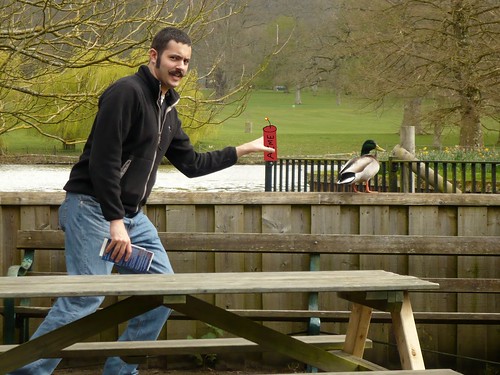 |
| (Fake dynamite) |
Subscribe to:
Posts (Atom)